
Arrest Records in Peach County
Several agencies can create a Peach County arrest report. The Sheriff's Office handles unincorporated enforcement and county booking. Fort Valley Police and Byron Police document city incidents. Georgia State Patrol handles state-highway activity, while Fort Valley State University Police may create campus records. Another authorized agency may also make an arrest inside the county.
The records do not merge into one public file at once. The arresting agency owns its report. The sheriff owns the booking entry. Magistrate Court or another issuing court controls warrant and first-appearance papers. A trial clerk keeps the later accusation, indictment, disposition, and sentence. GCIC compiles identity-linked state history from fingerprints and later reports, but reporting gaps and timing can leave the sources out of sync.
No Peach County Booking Log
No official browser-based Peach County inmate roster or booking log was confirmed in the available official sources. Do not treat an unofficial site that uses the county jail's name as a government record. Call the sheriff or jail for present custody, then ask for the booking number, booking date, accepted charges, bond, and release or transfer status.
A phone answer is a live snapshot. A produced booking sheet documents what the jail system recorded at a certain time. Very recent entries can change after bond, transfer, charge correction, or another hold. Absence from a current-custody answer says little about an older Peach County arrest.
Peach County Arrest Lookups
Start with location and agency, since those facts determine who owns the report. Then build the record across each official layer. This process is more reliable than searching one name on an unofficial booking site.
- Identify whether the event occurred in Fort Valley, Byron, on campus, on a state highway, or in unincorporated Peach County.
- Contact the sheriff or jail for current custody and the booking number; no verified official web roster is available.
- Request the incident or arrest report from the arresting agency using the date, place, subject name, and report number when known.
- Ask Magistrate Court about warrant or first-appearance material and the proper trial clerk about filed charges.
- Use GCIC for your own statewide history, Georgia Felon Search only for its limited public felony-conviction result, and a focused Georgia Open Records Act request when direct access fails.
After a state-prison transfer, search the Georgia Department of Corrections Offender Search. Use the federal locator only for federal custody. Court dates should always be confirmed with the clerk.
Reports at Spruce Street
The Peach County Sheriff's Office report counter is at 1007 Spruce Street in Fort Valley. Request an incident or accident report there when the sheriff created the agency record. For booking material, name the booking sheet, charge and bond ledger, release or transfer entry, and photograph status only if the image is lawfully available and truly needed. The official sheriff report-copy page is the source for that channel.
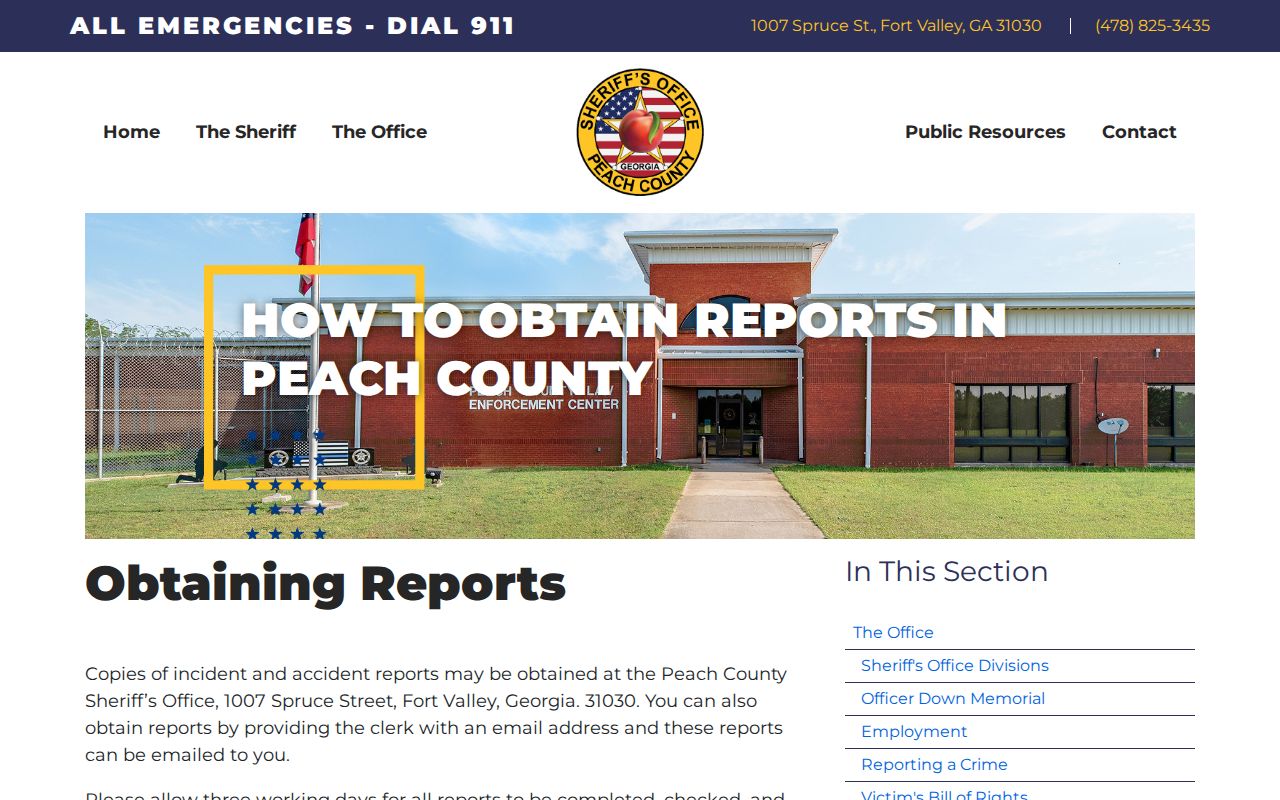
The sheriff's page routes readers to an official record source without presenting a mugshot gallery or unofficial arrest list.
Peach County Sheriff's Office
Report counter
1007 Spruce Street
Fort Valley, Georgia
Ask separately for the agency report and the booking record because they contain different facts.
Arrest Records: What They Contain
A Peach County agency report explains the officer's event: incident type, time, location, officers, narrative, probable cause, subject identifiers, witnesses, evidence, offenses, and warrant details where applicable. The jail booking record focuses on intake and custody. Read each field as a point-in-time entry, not a final court finding.
| Booking number | The jail's identifier for the intake |
|---|---|
| Booking date and time | When intake was recorded |
| Arresting agency | The office that created the arrest report |
| Charges | Counts accepted at booking, subject to later change |
| Bond | Amount and type by count when recorded |
| Photograph status | May be part of booking, but no official Peach County gallery was found |
| Custody status | Housing, release, hold, or transfer information |
Operational identifiers may include a SID, OTN, FBI number, warrant number, or fingerprint transaction. The filed court charge can differ from the booked charge.
Peach County Arrest Record Custodians
The right request depends on the record component. Ask Fort Valley Police for a city incident or arrest report at 478-825-8261. Byron Police's Administrative Division maintains department records; its office is at 401 Main Street, Byron, with telephone 478-956-3600 and fax 478-956-5299. A state-highway report goes to the Georgia State Patrol or Department of Public Safety office identified on the report. Campus material goes to the university public-safety custodian after confirming which agency responded.
For probable-cause facts, property, evidence, or the officer narrative, ask the arresting agency. For intake time, booking identifier, charges accepted by the jail, bond, and transfer, ask the sheriff. Warrant affidavits and first-appearance orders belong at Magistrate Court or the issuing court. The accusation, indictment, and disposition come from the trial clerk.
Note: A sealed warrant or active investigation may limit access even when other parts of the Peach County arrest record are public.
Recent Peach County Bookings
Because Peach County has no verified official public roster, a recent-arrest check begins with direct jail contact. Ask a narrow set of questions: whether the person is in current custody, the booking number and time, charges received, bond as currently shown, and whether release or transfer has occurred. Record the time of the answer because custody can change.
Do not infer release from a bond amount. A second warrant, probation hold, no-bond condition, or processing delay may keep a person in custody. Nor should a jail charge be treated as the final accusation. The prosecutor can amend, reject, or replace it after reviewing the agency report. The Peach County court case lookup is the better source once charges are filed.
Peach County Booking Data to GCIC
At intake, the sheriff records identity, property, screening details, photograph, fingerprints, charges, warrant information, and housing classification. Fingerprints and arrest data then travel to the Georgia Crime Information Center, the central repository within GBI. Courts, prosecutors, and supervision agencies later report dispositions and corrections.
The GBI criminal-history service describes the statewide record and its access routes.
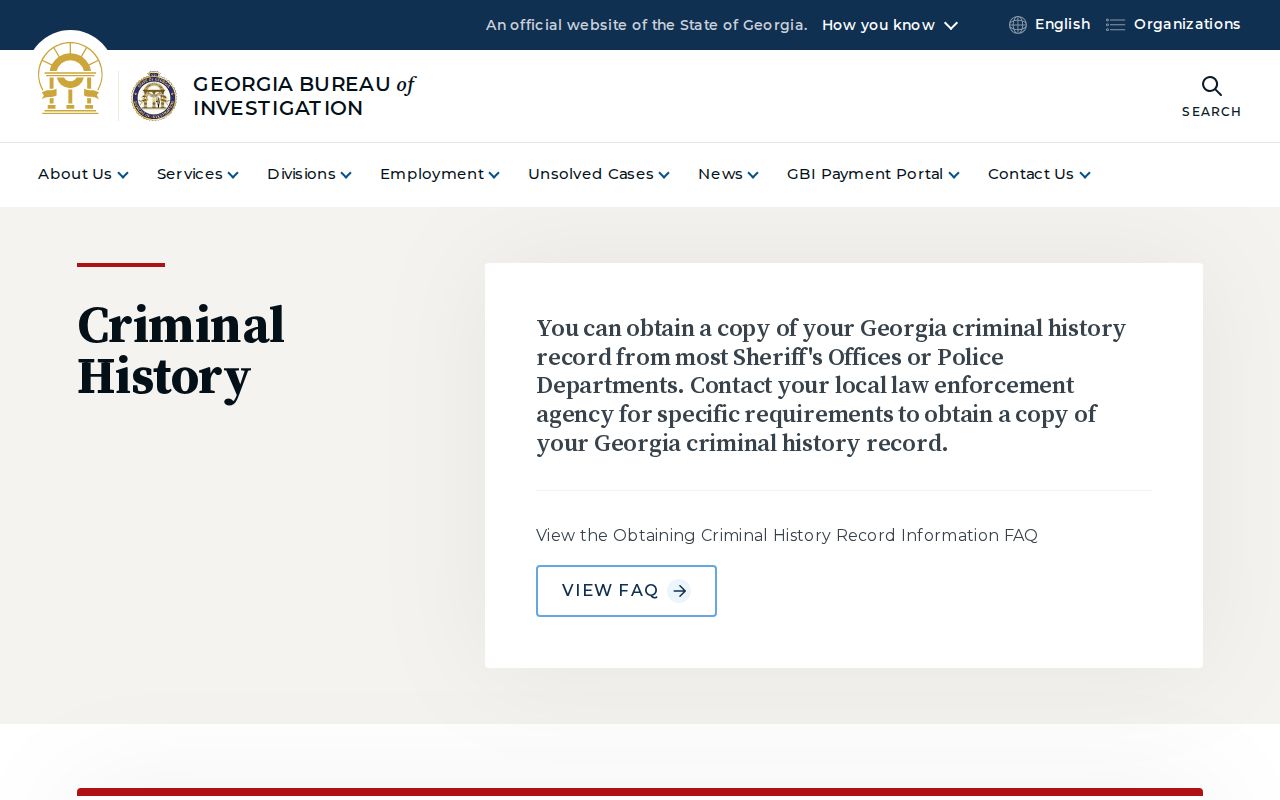
The GBI source explains the state layer, which is broader than a single Peach County booking sheet but can still depend on local disposition reporting.
The GBI criminal-history questions page clarifies common limits and procedures.
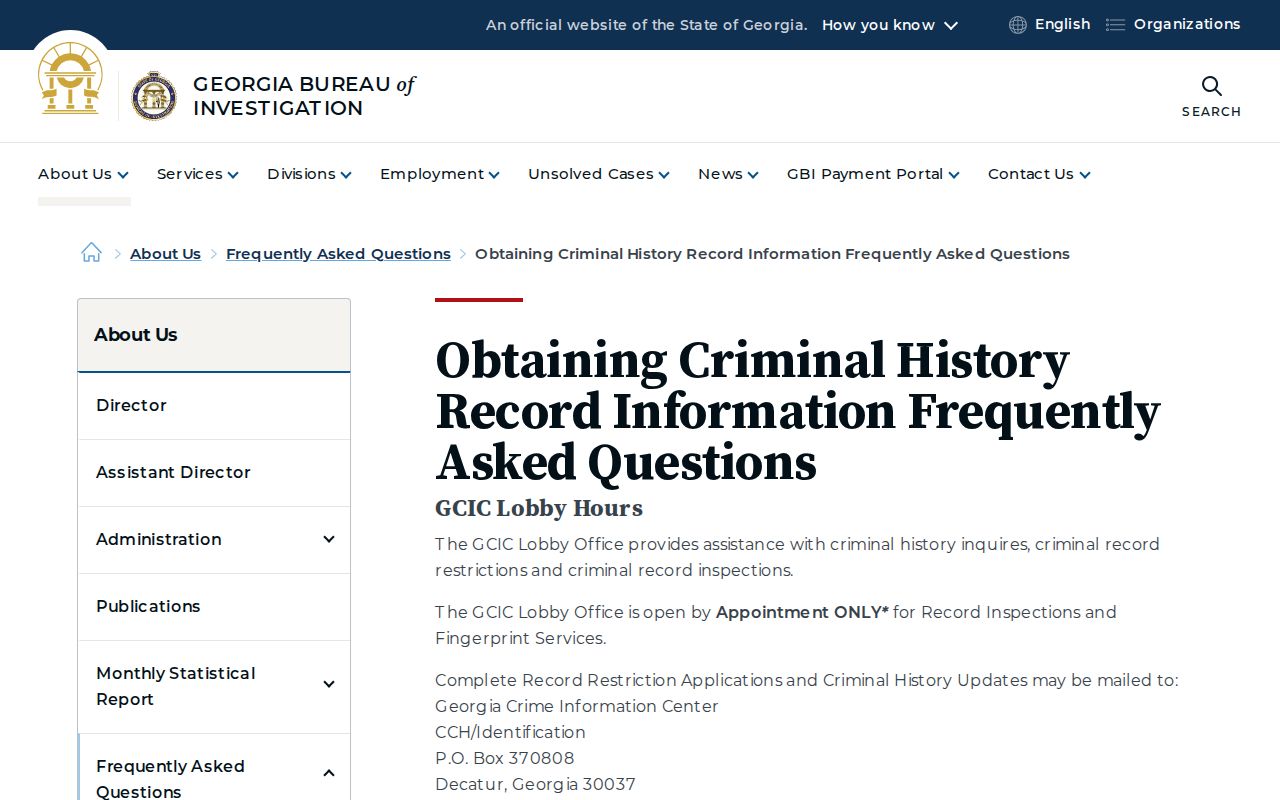
Those answers help distinguish a personal record inspection from the limited public felony-conviction product.
Correcting Peach County Arrest History
Review your own GCIC history when a Peach County arrest has a missing or wrong outcome. GBI states that GCIC cannot change submitted information without documentation or authorization from the agency that supplied it. Arrest and identity corrections route through the submitting criminal-justice agency, while courts and prosecutors can transmit final dispositions.
Obtain a certified disposition from the proper Peach County clerk if the local case shows dismissal or another result that is absent at GCIC. Then follow the agency and GBI correction channel. Personal fingerprint-based checks use Georgia Applicant Processing Service, operated by IdentoGO/IDEMIA. Registration starts with the service code for the authorized purpose.
The official GAPS registration service handles appointment and print-site selection.

GAPS supports an identity-based review of one's own state record rather than a general Peach County booking search.
Peach County Arrest vs Conviction Records
An arrest proves that an agency took enforcement action and, when custody occurred, that booking was recorded. It does not prove guilt. A conviction follows a plea or verdict and a court judgment. Initial Peach County charges can be declined, amended, dismissed, dead-docketed, or resolved without conviction.
| Arrest record | Conviction record |
|---|---|
| Created by an arresting agency and jail | Created by the court |
| Shows an event and booking | Shows a finding of guilt |
| Lives with the agency and sheriff | Lives with the clerk and may report to GCIC |
| May end in release or no filed charge | Ends in judgment, sentence, appeal, or later relief |
Note: A Peach County arrest is not proof of guilt, and many initial charges change or never produce a conviction.
Peach County City Arrest Layers
A Fort Valley arrest can produce at least three distinct records: the police report, the sheriff's booking entry, and a municipal or county court file. If a state misdemeanor transfers after a jury demand, the city clerk may have only the early portion. For Byron, substitute Byron Police and Byron Municipal Court. A GSP highway arrest still produces a sheriff booking and court trail when booked and prosecuted locally.
A focused request should seek existing records, not ask the custodian to write a new account. Identify the report number and event date, request the report and supplements, ask for segregable nonexempt portions, and request the cited exemption for any withholding. Seek an estimate before ordering costly audio or video.
Use the event location to resolve uncertainty. An address inside city limits points first to the city police department, while an unincorporated location points toward the sheriff. A highway stop may belong to GSP even when booking occurred at the county jail. On the Fort Valley State University campus, confirm which public-safety agency authored the report before sending a request.
Keep each response with its source and date. The agency narrative, booking sheet, warrant paper, and court disposition answer different questions. Comparing them can reveal a charge change or a later release, but one office should not be expected to certify another office's record.